Showing posts with label Monarda fistulosa. Show all posts

Wednesday, August 28, 2013

Wildflower Wednesday


Normally starting to bloom in July, Lobelia cardinalis (cardinal flower), like quite a few others this year, is blooming a bit later than usual.  The cooler-than-usual spring and early summer may be responsible, or maybe it's because I pinched them to help prevent sprawling.  It's the first time I've pinched them.  I hoped it wouldn't prevent them from blooming, and it didn't.  I definitely like them better more upright.  I don't think the hummingbirds care.  Cardinal flowers attract hummingbirds here like nothing else except the fuchsias we pot up every year.
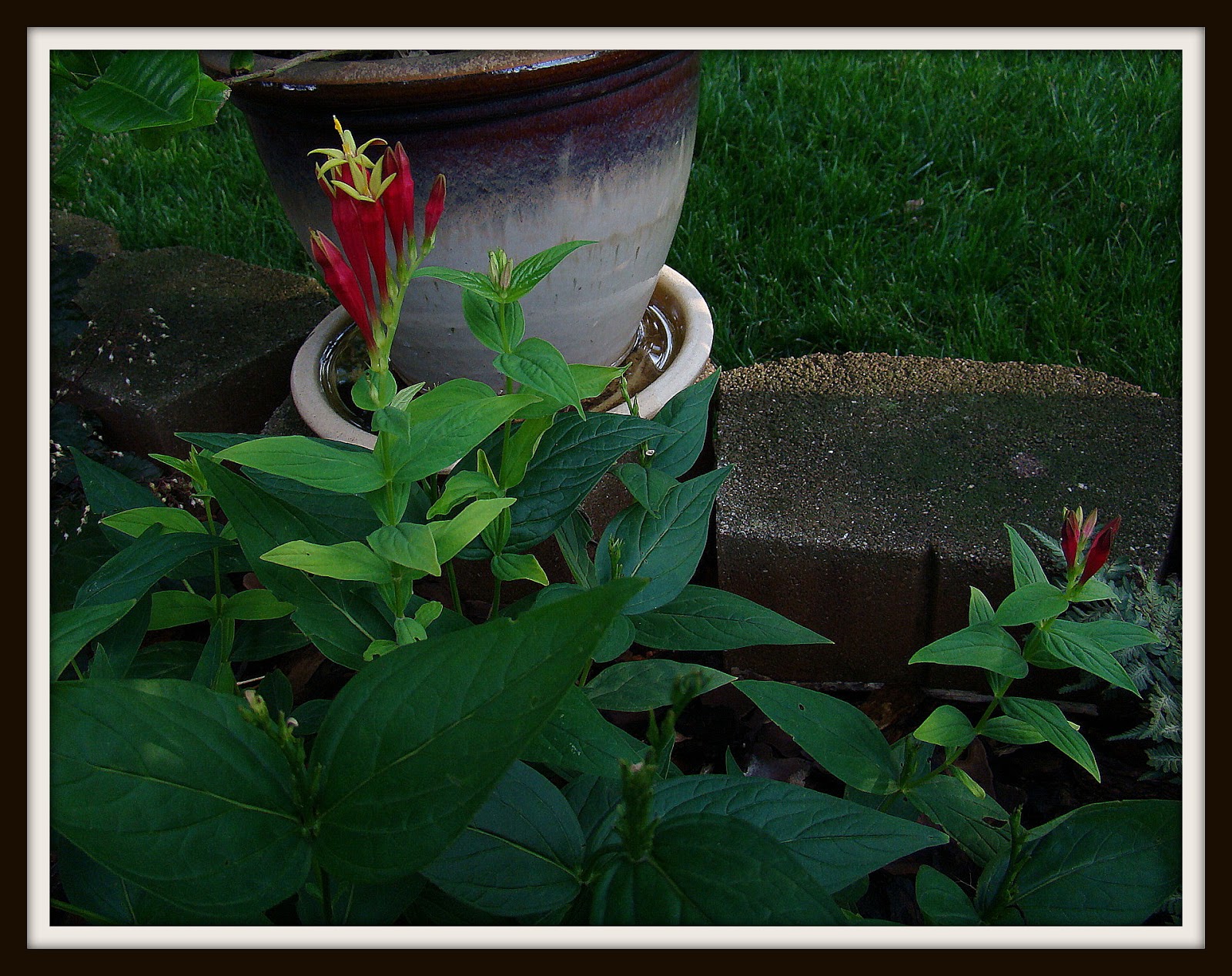

Spigelia marilandica/Indian Pinks are reblooming!  They usually do, though not as prolifically as their initial bloom in June.


Helenium autumnale, a/k/a sneezeweed, just getting started.


Earlier in the season somebunny chewed Elymus hystrix (bottlebrush grass) to the ground.  It rebounded, and is blooming here for the first time.  We started bottlebrush grass from seeds Monica sent in spring 2012.  She sent seeds for several native grasses, and all were very easy to start and grow. I put it here in this messy-looking border in front.  I'm still working on convincing the Lawn man we need to yank the ugly yews and Euonymus.  I think I'm getting closer . . .


Monarda fistulosa isn't blooming in the original spot I planted it.  I moved a clump to a sunnier spot this spring, and I'm happy to see it doing so well here.


Joe Pye weed, formerly known as Eupatorium purpureum, now Eutrochium purpureum,  was a flopping mildewed mess and hardly bloomed at all during last summer's heat and drought.  They've recovered beautifully this year, though not quite as tall as usual.  I've said it before and I'll say it again:  I really wish 'they' would quit re-classifying and re-naming plants.  It took me a long time to learn so many botanical names, and I'm getting too old for this!


Related to Joe Pye, I believe, this volunteer mystery plant appears to be a eutrochium/eupatorium.  For the first time, it decided it wanted to turn a nice dusty pink this year.  We lost a spruce that gave this plant a lot of shade in previous years.  The shade never prevented it blooming, but it's much taller this year, and it's nice to see the pink!  In the past this plant produced white flowers that faded to a rather unattractive gray.   This year they started white and aged to pink!  Whatever it is, it attracts an unbelievable number of bees of every kind.

Please visit the  host of Wildflower Wednesday, Gail at Clay and Limestone, where today she's featuring Blue Mist Flower/hardy ageratum.  Her in-depth posts on natives she grows in her garden are educational, entertaining, and feature gorgeous photography, as well as links to many other Wildflower Wednesday posts. 

Wednesday, July 25, 2012

Wildflower Wednesday

Monarda fistulosa

This summer's been rough on humans and wildlife, crops and livestock, lawns and gardens.  Still, with a little extra help from the end of a hose, our garden is weathering Mother Nature's and climate change's challenges.

With our early hot weather, plants bloomed early. Now, in July, that seems to have mostly leveled out, with most  bloom times pretty normal. What has been off is height.   A lot of stuff is shorter than usual - in some cases several feet shorter.


Lobelia cardinalis have their share of challenges this summer. One disappeared, one got smashed by a fallen branch during a recent storm, and this one . . . well, at least it's blooming.

They like moist soil, and live in an area of our swale that stays moist all year, normally . . .


This summer  has been lots of things, and normal isn't one of them.


Most of the purple coneflowers are two feet tall and under.  Most of the phlox, and everything in this part of the garden is shorter than usual.


Joe Pye Weed is a few feet shorter than usual, along with way-shorter-than-usual  Rudbeckia 'Herbstsonne.'   Besides being shorter, lots of stuff is less full too.


Nodding onions, Allium cernuum, seem oblivious of the heat and drought.


Culver's root, about finished blooming, is weathering the weather well.


A volunteer eupatorium (or do you say eutotrichum?) seems unfazed by the weather.  It's one of few July bloomers, whether native or  cultivar, that's its usual size.

Our small corner of the world has been hot and dry most of the summer along with much of the country.  Lately, there's been welcome relief with a few mid-80-degree days, and a few good deluges.  The occasional breaks from lugging hoses feel luxurious.


Anyone who says sunshine brings happiness has never danced in the rain. ~ Unknown


To see more Wildflower Wednesday posts, please visit Gail at Clay and Limestone.


Wednesday, August 24, 2011

Wildflower Wednesday

On Wildflower Wednesday, the fourth Wednesday of each month, we join with Gail to celebrate and share the love of native plants and wildflowers across the blogosphere. Wildflowers are beautiful, easy-care additions to any garden, and there are wildflowers suited to any challenging combination of climate, soil, moisture, critter, and sun conditions you might have.

We have a little sunny space in our front yard, but most of our garden space is in back in beautiful, loamy soil. While the soil is great, we're challenged by gardening in the shallow roots of three mature silver maples, where there's little sun, the soil tends to dry out very quickly, and it can take years for new plants to become established. Many native plants and wildflowers have been equal to the challenge. These are the ones we find blooming here this month:

Allium cernuum, or nodding onions, came to live here last year, divisions shared with us by Monica. Tough, easy-care, and seldom bothered by animal or insect pests, their delicate blooms are a welcome addition. Nodding onions are attractive to pollinators and will thrive in full to part sun.

Eupatorium purpureum - Joe Pye weed is a tall plant excellent for the back of the border, with showy flower heads that last a long time. After the flowers fade, the seed heads can remain attractive well into the winter. Joe Pye weed is equal to the challenge of growing in a very dry area of our garden where the roots of the maples mingle with the roots of an old, mature arborvitae hedge.

Monarda fistulosa, a native bee balm, is doing well in its third year here. Although monardas are often plagued with powdery mildew, this one has shown no sign of it so far. Bee balm is a good name for it, considering how many bees visit this plant every day. We have lots of bunnies here, but bee balm is equal to the challenge they present, since our bunnies don't seem to like the taste of it's wonderfully fragrant foliage.

Phlox paniculata cultivars are abundant here. This seedling of unknown parentage turned up last year. Hummingbirds, butterflies, and bees don't care about its pedigree, and enjoy it just as much, if not more, than the cultivars. Phlox blooms well even in some of the challenging shadier spots in our garden.

Now that the main garden area in back is fully planted, in the last three years, we've expanded into the swale way in back. It's a mostly shady area where moisture conditions vary from a shallow area that never dries out to the deep end that goes from constantly flooded in winter and spring to bone dry in summer. We're still working out what, if anything we can plant in the deep end. The shallow area is perfect for moisture-loving, beautiful natives that don't mind the challenge of wet feet, like Lobelia cardinalis, or cardinal flower. Hummingbird magnets, cardinal flowers are hands-down their favorite blooms here.

Helenium autumnale, also called sneezeweed, was started from seeds last year. They bloomed their first year, and are budding again now. They're thriving in the shallow end of the swale too. They too like moist soil and don't mind wet feet. This one was pinched in early July as an experiment, while the others were left to grow as tall as they wanted. Next year they'll all be pinched. All but this one flopped, and it has more buds than the ones that weren't pinched.

Late last winter I ordered seeds for Lobelia siphilitica. Blue lobelia, cardinal flower's cousin, seemed a nice addition to the shallow end of the swale. From an entire packet of seeds, only two germinated, and only one survived the seedling stage. The little lobelia was carefully nurtured until, during it's first week outdoors, in a pot on the edge of the west veggie bed, some critter bit off its little crown. In the bed, wilted but intact, the severed section was found. After re-hydrating it in a cup of water, it was planted in fresh potting soil in a small nursery pot in hopes it might root itself in case the original plant didn't re-grow.

The original plant grew new leaves and survived, and the decapitated portion grew roots, so now we have two! Both are budding in their first season, despite their early trauma. Now they live in the shallow end of the swale, where they were transplanted back in June. I expect they'll be equal to the challenge of wet feet. Hopefully they'll survive the challenge of the bunnies. Maybe in September we'll see some blooms.

We added two little prairie smoke (Geum triflorum) plants three springs ago. One disappeared last fall, and the remaining one bloomed for the first time this spring. One of the blooms set seeds. A few seeds were collected, and started under the light in the basement. In the next few weeks they'll find homes in the garden near their parent that has so far proven itself equal to the challenges of dry soil and and not much sun.

Every garden presents challenges. Through research, trial and error, and experience, native plants can be found which will not only survive, but thrive in nearly any challenging garden conditions we may have.

For more Wildflower Wednesday posts, please visit sweet Gail at Clay and Limestone.

Sunday, May 2, 2010

And the Winner Is . . .


Last weekend while K, her new daughter, and I attended a wild foods/medicinal plants seminar, Monarda fistulosa was serendipitously announced as the winner of this year's One Seed Chicago votes.

Wikipedia says Several bee balm species (Monarda fistulosa and Monarda didyma) have a long history of use as medicinal plants by many Native Americans. . . who recognized the strong antiseptic action of these plants, and used poultices of the plant for skin infections and minor wounds. A tea made from the plant was used to treat mouth and throat infections, and is the source of the antiseptic Thymol, the primary active ingredient in modern commercial mouthwash formulas. The Winnebago tribe used a tea made from bee Balm as a general stimulant. Bee balm was also used as a carminative herb by Native Americans to treat excessive flatulence. An infusion of crushed Monarda leaves in boiling water has been known to treat headaches and fevers.

Although somewhat bitter, due to the thymol content in the plants leaves and buds, the plant tastes like a mix of spearmint and peppermint with oregano, to which it is closely related. Bee balm was traditionally used by Native Americans as a seasoning for wild game, particularly birds. The plants are widespread across North America and can be found in moist meadows, hillsides, and forest clearings up to 5,000 feet in elevation.


While I voted for nodding onion, One Seed Chicago provides compelling reasons to be happy bee balm is the winner: "The past few years have seen an interest in the health of insect pollinators as a sign of a breakdown in our agricultural systems of production," says Michael Thompson, Farm Manager of the Chicago Honey Co-op. "Providing habitats with nectar forage for pollinators is a positive way to help with the decline in pollinating bees and other invertebrates."

"Native plants attract native birds and insects and help to increase biodiversity in your garden," says Jennifer Davit, Director and Horticulturalist at the Lurie Garden at Millennium Park. "Our native plant friends are more adapted to their local surroundings and can handle the Chicago area's fluctuations in climate and weather."

It's not too late for Chicago-area teachers and residents to request a free packet of bee balm seeds. Please consider participating with us in this community effort and help our native bees by planting this pretty, beneficial plant in your own home and school gardens. For more information and to request seeds, please visit One Seed Chicago.