Wednesday, April 25, 2012

Wildflower Wednesday


These are buds and teeny-tiny blooms of Cornus sericea, commonly called red-twig dogwood.  They're on one of many branches cut and used with evergreen boughs and pinecones to decorate containers last winter.  Most of the cut branches are leafed out, and even rooting.  Some are blooming, and they'll be left until next month when it's warm enough for summer annuals.  A few will eventually be planted along an open section of our back property line.  At maturity they'll be about six feet in diameter and ten feet tall, enclosing the last open border in our back yard.  In the part-sun, moist-soil conditions they like, they'll be fast-growing shrubs, so it won't take very long.

Red-twig dogwoods aren't known for showy flowers.  They're known for their branches.  Green spring through fall, they turn brilliant red as the leaves drop in late fall, and they stay red all winter. They're fabulous against the snow, and beautiful in winter containers. The branches in our containers were cut from a dogwood in our backyard.  They went straight into the pots with the bottom six inches or so poked into the soil.  To give them their best chance at rooting, they were cut fresh from the shrub immediately before potting.   They got no special care over the winter.  The evergreen boughs insulated the soil and helped keep it moist.  A few weeks ago when the weather got hot and dry, the evergreens came out and I started watering the dogwood twigs, keeping the soil evenly moist to encourage rooting.

Before the pots are filled with annuals, I'll carefully dig up the rooted branches, and transfer to them to gallon-size nursery pots. The pots will be placed in an out-of-the-way mostly-shady spot over the summer, and watered regularly. By fall they'll be ready to plant in the ground.  Extras can be shared, traded at plant swaps, or donated to garden club or charity plant sales. 


Senecio aureus is blooming about a month earlier than usual thanks to our extraordinarily warm March.  Migrating Red Admiral butterflies were all over the blooms last week.


The Red Admirals were loving Phlox divaricata, too.  Of course, when I had time in the garden with the camera, the butterflies were nowhere to be seen.

Celandine poppies, (Stylophorum diphyllum) also native wildflowers, are blooming behind the phlox, next to the kids.


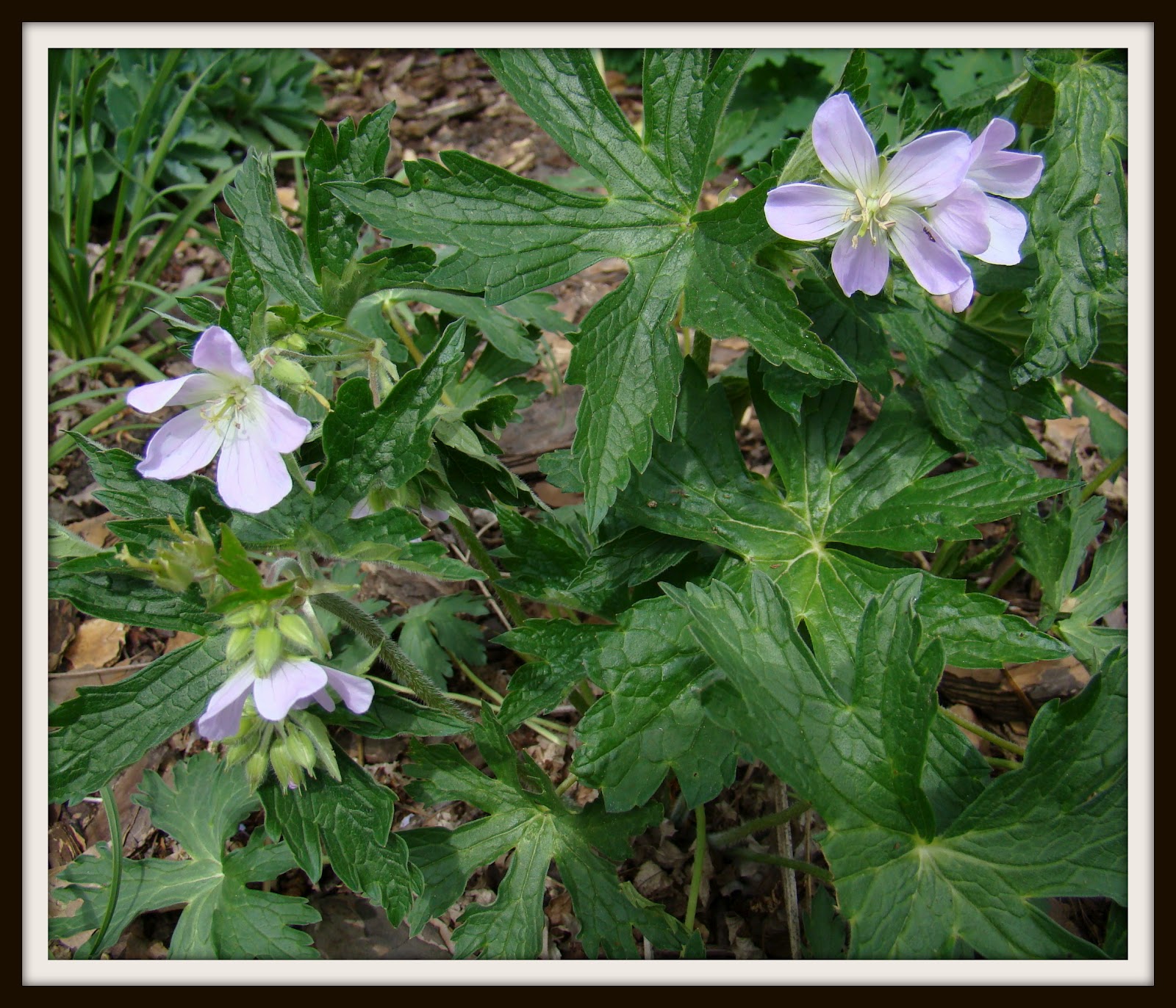
I first spied Geranium maculatum about three years ago, during Spring Fling Chicago, at the Alfred Caldwell Lily Pool garden in Lincoln Park on Chicago's north side.  Not long after, this one came to live in our garden.


After years of planting columbine cultivars only to have them disappear in a year or two, we added a few natives. Columbine canadensis keep coming back year after year, and will easily self-seed if you let them.  If you don't want seedlings, just cut back the scapes when they're done blooming.


Dicentra cucullaria, commonly known as Dutchman's Breeches, were transplanted here from Mom's woods three springs ago.  They're still settling in, and haven't bloomed yet.  Maybe next year!  As long as they keep coming back, I can be patient.


Podophyllum peltatum, also called Mayapples, came from Mom's woods three years ago too, where there's a large colony of them.  They bloomed here for the first time last spring.  This one was moved last fall to make room for a new garden path. I was thrilled to see it bloom again this spring. Mayapple blooms hide under the leafy canopy of their umbrella-like foliage.  They're worth looking for!

The wildflowers pictured are all native in Illinois, and all make wonderful spring bloomers for woodland gardens.  They not only survive, but even thrive in the root zones of mature silver maples in our suburban garden.  They provide nectar for pollinators, and endless pleasure for us.  

Gail at Clay and Limestone hosts Wildflower Wednesday the fourth Wednesday each month.  Visit her blog to see what's blooming in her Tennessee garden and find links to wildflowers blooming in gardens everywhere.

Saturday, April 14, 2012

April Bloom Day


 After a March that felt more like late June, April's more normal temperatures are welcome.  The cooler temperatures haven't slowed down blooming around here though.

The 'Brushstrokes Strain' hellebore is still budding and blooming. It's nice to see the fresh blooms, since the older ones faded quickly in the heat.  Although the colors fade, this hellebore holds its blooms until late fall.


Virginia bluebells, Mertensia virginica are nearly finished.  They bloomed a month earlier than usual.


'Jack Frost' brunnera has been blooming for a few weeks.  I love this plant, with and without blooms.


Veronica repens was a favorite of my friend Meg's.  I have it here now in her memory.

Maple seeds are everywhere.  I'm so used to seeing them, I didn't notice these two when snapping the photo.  They  give some perspective on how dainty this plant is.


Anemone 'Sylvestris' is just getting started.   These languished until I moved them a couple of years ago.  Funny how a few feet can make such a difference.  They're happy in their new spot.


Speaking of how moving a plant a few feet can make a difference, Phlox divaricata  were moved last fall.  They were among the first plants to follow me here 8 years ago.  They barely survived, and bloomed only once in all that time.  These are the blooms I'm most excited about this month.  I'd almost forgotten what the flowers looked like, it's been so long since they've bloomed.  They were only moved a few feet, but it's made a huge difference in their health, and THEY'RE BLOOMING!


Celandine poppies have been blooming about a month.  I love the foliage as much as the flowers.


Candytuft started from seeds bloomed last spring for the first time, after waiting patiently for three years.


'Pink Pewter' lamium is another plant whose foliage is wonderful.  Lamiums can be pretty 'spready,' but here, after 6 or 7  years they're still well-behaved.  If they ever spread too much, they're easy to pull.


Speaking of  aggressive plants, I'm debating with myself on this dwarf comfrey, Symphytum grandiflorum from a plant swap last year.  Comfrey makes excellent compost tea, and honey bees love it.  Those two facts seduced me. I might chicken out and dig it up, or at least move it to a spot where it can be contained.  It's a pretty plant, and I love the blooms, but it will be watched very closely for now.  "Spreads by underground stolons" is a plant description that makes me shudder.


I noticed we have a few bleeding heart seedlings this year. Bumble bees are all over it when it's in bloom.

If any of the seedlings survive, they'll be great for plant swaps (not that I need any more plants!)

There's a 'Gold Heart' dicentra waiting to go in the ground this year, but it's somewhat the worse for wear after shipping, so it's being babied in a pot for now.


Golden ragwort, Senecio aureus is blooming.  This is a pretty aggressive plant in our garden.  So far, pulling the pieces that run seems to be keeping it in check.   There are several reasons to love this plant - it's a native, the blooms are sweet, the foliage is very pretty, and it's evergreen.


Geranium maculatum started blooming this week.  This is the bloomingest April ever in our garden.  So many things are blooming early.


Columbine canadensis blooms are just starting to open.  I love their graceful, arching habit, and long bloom period.


The strawberries were started from seeds from Renee's Garden last year.  We even had a few berries their first season.  They're tiny berries, about the size  of my ring fingernails, but so fragrant and delicious.  The seeds germinated easily with no pre-treatment.  The plants are pretty, and even stayed green all winter.  They're well-behaved too - no runners.  The clumps grow, but they don't spread.


There are a few other things blooming, but we'll leave it at this for now.  It's an embarrassment of riches in the garden this month. It makes me wonder if there will be anything left to bloom in the fall.  I'm pinching a number of plants to slow down their bloom.  In many cases pinching perennials also helps keep them from sprawling.

Happy Bloom Day everyone!  To see more blooms from gardens around the world, please visit Carol at May Dreams Gardens. 


Monday, April 9, 2012

Ed and Zelda, Just Passing Through


This time of year the deepest part of our swale usually becomes a vernal pool, and Ed and Zelda visit the pool a few times a day for a swim and a meal. 

A vernal pool is ephemeral, much like many of the spring natives in our garden.  That is, it's temporary, lasting only a short time, and returning year after year.   They are low spots in the land where snow melt and spring rains collect, and they're usually dry, or mostly dry during summer and fall. 

Vernal pools usually contain no fish, making them mostly free of predators and allowing a place for amphibians like toads and frogs to visit and lay their eggs. With enough rain our vernal pool stays full long enough for tadpoles to fully develop into young adults able to walk,  hop, and breathe on land.  The years when we have toads in the garden are generally years when we've had a lot of snow, and a normal amount of spring rain, and our vernal pool lasts at least several weeks before going dry.  

This year so far, we've had neither a normal amount of snow, nor much in the way of rain.  As it was in much of the country, March was unusually warm and dry here.  So far, April has been more seasonal temperature-wise, but we're still very short on rain.  What this will mean, if anything, for the rest of the year remains to be seen.

For Ed and Zelda though, it has meant not much to eat in the swale.  They waltzed past the dry, deepest part of the swale to this area which is always moist.  They dipped their bills into the murky water a few times, and appeared to find something to eat. 

Since they wouldn't have seen water from air as they were flying over, the fact that they stopped here anyway makes me wonder.  I like to pretend Ed and Zelda are the same pair of mallards that return here to feed and swim every spring.  Maybe they really are, and maybe that's why they landed, expecting to find the usual vernal pool.  Or, maybe there's some instinctual behavior passed down through generations like our GPS navigators in our cars, so that even young birds who've never been here, somehow know their parents were.

There's been a lot of talk about global warming during the winter that wasn't and the record-high March temperatures.  Whatever the facts are, I felt a little sad for Ed and Zelda, and wonder what temperatures and how much rain this summer will bring. All I know right now is there was no place here to swim, and not much for them to eat.  This spring, as happy as I am to see them, Ed and Zelda are just passing through.

Thursday, March 15, 2012

March Bloom Day


Like much of the country, it feels more like late spring or early summer here than the waning days of winter in mid-March.  It looks like daffodils will open very soon, maybe even later today.  They usually wait until April.


Snowdrops have been blooming for over a week.

Helleborus niger seems to be a slow grower.  It bloomed last spring for the first time, with just one flower.  I thought there might be more this year, but again, there's just one.


This hellebore is "Brushstrokes" strain  It was the first hellebore in our garden.  It was so big last year I divided it, and donated the divisions to our garden club plant sale last June.  The divisions never made it to the sale table.  As I walked into the room with them, people snapped them up immediately, before they'd even been priced.


Indoors, our Thanksgiving cactus, Schlumbergera truncata is reblooming.  It bloomed in November and December, and had buds all winter.  The buds all fell off before they opened until this month when several have held on and opened.  There are still quite a few more buds left.  This is the first time it's rebloomed, hopefully not the last.

Happy (very early) Spring everyone!  For more Bloom Day posts, please visit Carol at May Dreams Gardens.

Monday, March 12, 2012

Chicago Flower & Garden Show


The Chicago Flower & Garden Show opened this weekend, and runs through next Sunday, March 18th.  This year's "Hort Couture" theme was playfully executed in flowers, fabrics, and furnishings throughout the exhibition hall.  

One of the more impressive shows in recent years, there was lots of eye candy, including this spectacular, 14-foot tall 1,100 pound galvanized steel and blown glass agapanthus sculpture in the "Making an Entrance" garden.  A creation of United Kingdom artist blacksmith Jenny Pickford, the sculpture was shipped from London where it had previously been used at the 2011 Chelsea Flower Show.

more art glass in the garden

The scent of hyacinths filled the air.

One of the best uses for silver maples I've ever seen, ;) this pergola was one of my all-time favorite Garden Show displays.  


The White House vegetable gardens have inspired novice and experienced gardeners all over the country, and home vegetable gardening is experiencing a renaissance after many years of decline.  Seed houses and nurseries have ramped up production trying to keep up with the unprecedented demand for vegetable seeds and starts.  


This display garden is a salute to the White House's 1,100-square-foot organic kitchen garden.  


As in recent  years, vegetables are once again playing prominent roles in many of the display gardens, demonstrating not only their usefulness, but also their beauty, and the roles they can play even in ornamental containers and gardens.

I loved the use of paint stirrers as plant markers.


Inspired by the New Orleans French Quarter, the Fleur-de-Lis was one of my favorite display gardens.


An eclectic mix of old-world charm and high fashion, un coup de chapeau to designers Christopher Holmstrom and Elizabeth Barnard.


"Front Yard Food `a la Francais" is Growing Power's creation, showing how food gardening can be not only practical, but beautiful as well.  I love how they incorporated logs into this design, and I really liked the 2"x4" plant markers.  This garden was rustic, lush, beautiful, and delicious.

And what would Chicago's garden show be without the over-the-top tablescapes!

What?  This is a tablescape???  Of course, silly . . . it's breakfast in bed!


"Project Someday" is this year's display designed by students at the Chicago High School for Agricultural Sciences.  I look forward to their gardens every year.


In fact, I think this just might be their best one yet.


The Ag. School's gardens always have a touch of whimsy.


I was very impressed with the kids this year.


It was a full day, capped off by The Great Chicago Seed Swap organized by Mr. BrownThumb, and manned (womened) by a group of volunteers including yours truly.  The swap was a lot of fun, and although I forgot my seeds at home, because I worked I was still able to pick several things to try including veggies, and  packets of downy skullcap and willow-leaf amsonia from the Lurie Garden.

Besides all the wonderful display gardens, the Chicago Flower & Garden Show hosts events and activities including potting parties, floral design and  hands-on garden-skills demonstrations, activities for kids, shopping , cooking demonstrations, and a full schedule of free talks on a variety of gardening subjects given by expert garden speakers every day.  

For more information, including a complete schedule of events, and to order discounted tickets, visit the show's website at www.chicagoflower.com