Tuesday, June 8, 2010

In Meg's Garden


I visited Meg's garden last weekend, the first time since her death.


Her long-time companion called, asking for help identifying plants, and guidance in their care. He arrived bearing farmers-market annuals - a few of Meg's favorites she ran out of time to pick up.


There were alot of self-seeded annuals, herbs, and veggies blooming exuberantly. Meg didn't have a separate veggie bed - perennial and annual ornamentals, edibles, and medicinals mingle and naturalize freely in a large bed near the back door. Many of her favorites - calendula, tomato, fennel, dill, eggplant, squash, arugula, green, purple, and variegated lettuces, chards, and her signature heirloom pumpkins and gourds are growing, as if Meg had planted them herself.


I am soothed by the movement of leaves, the touch of the breeze, the gentle interplay of light and shadow. . . As the days pass, I'm grateful for the support of the earth. . . and for friends who have held me up when my heart was heavy.

She saw potential in a tired, run-down, but adorable vintage dollhouse - how she loved this place! In three short years she transformed the interior and nearly-featureless lawn into a lovely, loved home and gardens, overflowing with personality and reflective of an artist's soul. This place is a part of her living on, where her spirit, joy, exuberance, love and imagination are felt, her smile seen, her laughter heard.

A life lived well is ultimately measured not by the momentous occasions of that life, but by how those moments have been spent.

She created a series of meandering beds and borders, unearthing long-buried rocks and flagstones, using them to create garden rooms. Flat-topped rocks and tree stumps became seating, and pedestals for pieces of her quirky collection of found objects and her own artwork. She had a gift for seeing beauty and usefulness in almost anything.


Meg called Autumn Bride heuchera her signature plant. It was in the gardens of nearly all her clients.


Her gardens are thriving - even the pansies she planted this spring are still lovely.

Another name for violets is heartsease - pansies may also be referred to by this common name. The leaves of violets or the flowers of pansies can help ease emotional as well as physical afflictions of the heart.

Friends, family, and neighbors come by regularly to weed and water the garden, and feed the cats - her indoor kitties, and the strays she fed on the front porch. On arrival, I found one of her neighbors, here with Bruno, her doggie companion, finding solace in Meg's garden, pulling creeping charlie in a sunny bed. I smiled, remembering countless hours spent with Meg pulling creeping charlie - hours spent in quiet companionship, lively and deep conversation, humor and playfulness - enjoying the warm, open, easy, close connection Meg shared with everyone she knew.


Meg was a kind, gentle soul. She left a legacy of wisdom, love, compassion, acceptance, deep spirituality, and, beautiful, poignant, comforting memories of the best kind of friendship.


The paradox I am wrestling with is how I can allow myself to be fully connected in love, knowing that loss. . . is always, eventually, inevitable. For me, the answer is that what exists in love becomes eternal. It will always be present as part of me, and through me, as part of the world. . . To paraphrase Tennyson, it is better to mourn the loss of that which we have loved in this world than to mourn the passing of each opportunity to love. . .

(The quotes are all Meg's. Besides being a gardener extraordinaire, and an artist, she was also a prolific writer, with published articles on gardening, herbs, and spirituality, and many personal, unpublished journals, essays, and poems. She would have been an awesome garden blogger.)

Saturday, June 5, 2010

Rainy-Day Shade Garden


Rainy days are perfect for enjoying the garden from indoors.

The second-floor views are among my favorites of the shade garden.

These photos were taken from our guest room and guest bathroom.

Where are your favorite rainy-day places to see your garden?

Monday, May 31, 2010

The Happy Nasties


What a difference a month makes! In case you missed it, here's what this pot looked like last month. Started in the basement under lights, the first nasturtiums were spindly and sad. During the past month, three of the original sad nasties expired. The three that remain have sprouted more leaves, and look much better. The seedlings started after the pot went outdoors are much happier and healthier-looking, and even cover the spindliness of the lower stems of the older ones.

Having never grown nasturtiums before, starting them in the basement was a learning experience. What not to do: Don't try to get a jump on the season with nasturtium seeds by starting them indoors. Even my expensive, high-powered sodium grow light doesn't provide the right light to produce sturdy, happy nastie seedlings. While adequate for stocky veggie seedlings, and overwintering tropical and tender plants grow and bloom happily under the light, nasturtium seedlings seem to need natural, full-spectrum sunlight for healthy growth.

Now that that's settled, I'm enjoying the cute round leaves on the happy nasties, and looking forward to buds and blooms.

I'm growing Nasturtium "Spitfire" for the GROW project. Thanks to Renee's Garden for the seeds.

Friday, May 28, 2010

A Truly Perennial Foxglove


Digitalis grandiflora

Though not as showy as Digitalis purpurea or many other (mostly biennial) foxgloves, Digitalis grandiflora is longer-lived. This one has been in our shade garden for five years.

It's lovely in a naturalistic setting, looks great with both hot and cool colors, and thrives here in dry shade. While not native, it's well-behaved in our garden and attractive to pollinators, including hummingbirds. In spite of its delicate appearance, it's a tough plant, unbothered by pests or diseases. Though it's never seeded itself in our garden, other gardeners have reported it to self-seed easily, almost invasively.

Digitalis grandiflora is one of the longest-lived perennial digitalis. Still, ours is old enough that one spring it may not come back. The last of three original plants, (I killed the other two trying to divide them,) last year I saved its seeds, shared some, and started a few in the basement over the summer. The seeds sprouted readily - 100% of them germinated. They were planted out last fall, and will probably bloom for the first time next spring.

Have you grown Digitalis grandiflora? If so what's your experience with it? This year I'll be saving seeds again, some for Monica, and am happy to share seeds if you'd like to try this lovely plant in your garden.


Friday, May 21, 2010

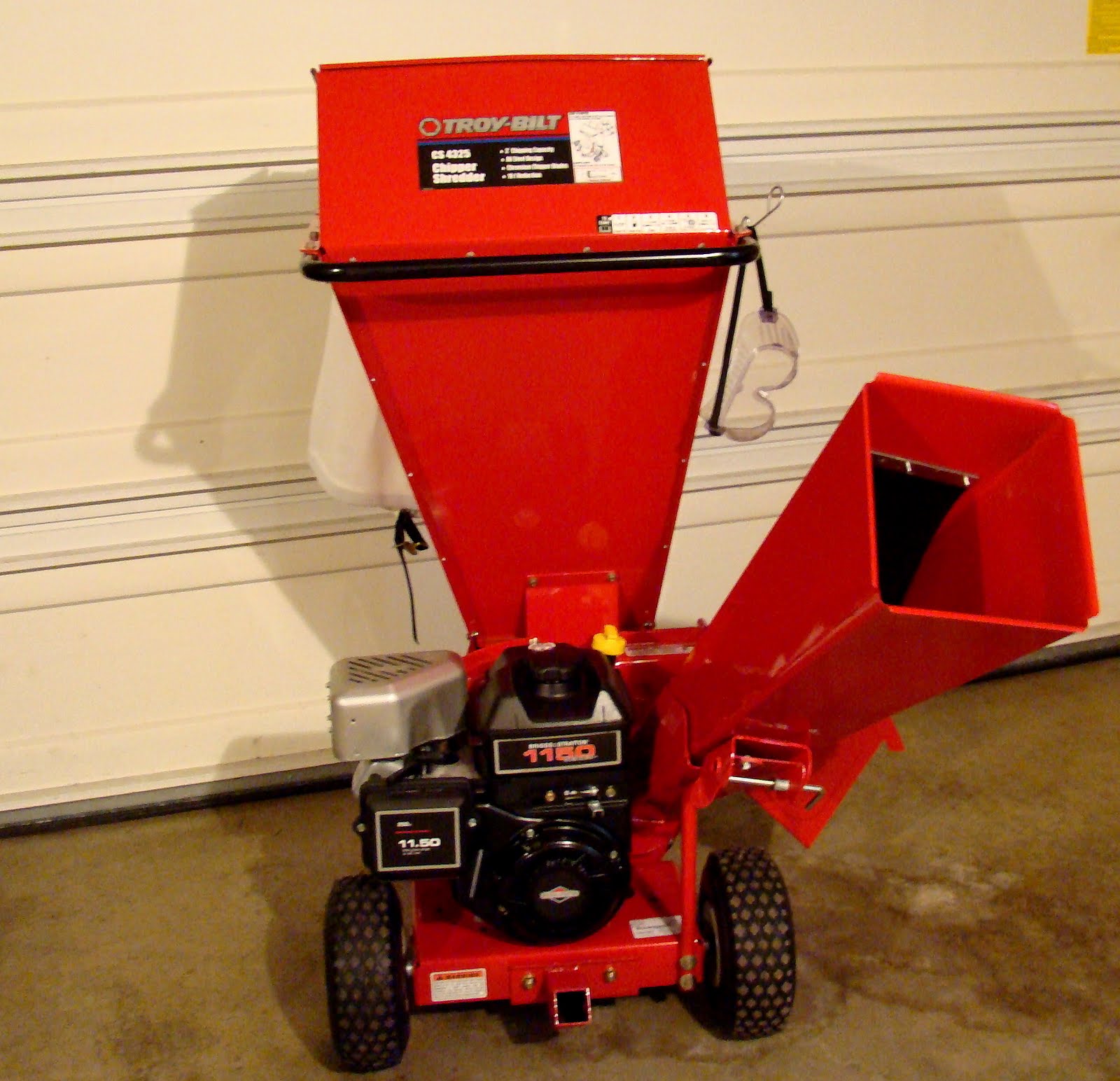
Troy-Bilt Chipper Shredder

The problem: Silver maples are messy trees, dropping buds and seeds, invading lawns and gardens with hundreds (thousands?) of seedlings every spring, and dropping twigs and branches all year long.

The contents of this 30-gallon trash can above, and this pile of twigs and branches below, accumulated over the winter. The Lawn Man used to pile them in the garden before it was a garden, and we've continued that practice until last year when they were kept here, next to the garage.

Our vacuum shredder has been used to turn branches into mulch, but with its one-inch hopper, the job was long and tedious, and hardly seemed worth the time and effort. It was tempting to just bag this stuff and send it to the municipal composting facility. I was dreading the shredding, but didn't want to send free potential mulch into the waste stream either.

I was thrilled earlier this spring when Troy-Bilt contacted me, offering the opportunity to choose, free-of-charge, almost anything I wanted from their catalog. Their only request was that after testing my choice, I would review the product here, providing my honest opinion, good or bad, of how the product worked for me.

After reading other bloggers' reviews, and Troy-Bilt's website reviews of most of their products and after consulting with the Lawn Man, this red beauty was selected. I hoped it would be the solution to the current mess on the side of our garage, and to future stick piles generated by a never-ending supply of falling maple twigs and branches.


It arrived earlier this week. A large crate was unloaded from the back of a semi with a lift gate, and the driver graciously wheeled it into our garage with our hand truck, immediately resolving my concern about whether I'd be able to get it from the truck to our garage in what was expected to be a curbside delivery. This machine weighs in at 200 pounds. When I asked about its size to make sure it would easily fit in our already-packed garage, its weight was more than a little intimidating. Aside from getting it from the curbside to the garage on a weekday when the Lawn Man was at work, I was sure he could handle its size and weight, but I wanted to be able to use it too.

Once in the garage, I uncrated it and was happy to find it fully assembled. After reading all the instructions, (especially the safety instructions,) adding the oil included with the machine and some gas, even I (those of you who know me, know I'm not exactly the biggest, strongest person around,) was able to easily maneuver this big, brawny machine out to the wood pile. I was impressed that it even fit (barely) around a tight spot between the corner of the garage and a landscape retaining wall. I donned the included safety glasses, and my leather gloves. It started on the first pull, and I went to work, feeding 1/2" diameter and smaller twigs into the large hopper (pictured below,) and up-to-three-inch branches into the narrower hopper on the right (pictured above.)
Midway through the job, over the sound of the machine I heard what sounded like a small metal thing hit something. I wasn't sure if something had fallen on the ground, or in one of the hoppers. My first thought was that one of the nuts on the inside of the hopper had come loose and fallen in. To prevent potential damage to the machine or kickback of whatever had fallen, I shut off the machine, inspected the inside of the hoppers and the sidewalk around it looking for a nut, bolt, or small piece of metal. Eventually I did find a bolt on the sidewalk, but couldn't find where it had come from. I didn't see any missing from the machine. Satisfied that maybe it was an extra one, I attempted to re-start the machine, but the pull cord wouldn't budge. "Uh oh," I thought, "I broke it!" I went back inside to consult the manual, and determined I probably needed to unjam the reduction chamber, where the shredder and chipper blades are housed. I followed the instructions for disconnecting the spark plug wire and making sure the machine was on the 'off' setting.

Since I'd stopped the machine abruptly, there were still some small twigs engaged in the blades in the middle of being shredded, and I realized that was probably why the starter rope wouldn't budge. I was kind of nervous putting my hands near the blades even though I followed the safety instructions to the letter, and I did have some difficulty reaching into the tight space allowed. But finally I did clear the blades, returned the chute deflector housing into the operating position, reconnected the spark plug wire, and restarted the machine, quickly completing my task. Later, when I was showing off the machine to my husband the Lawn Man, he immediately noticed a bolt was missing from the pin that holds the chute deflector on the machine housing. Since it fell off during the first time the machine was operated, it may not have been secured tightly enough when the machine was assembled at the factory. I'm glad it didn't cause any problems other than the jam that occurred when I abruptly shut off the machine.


Once all the branches were shredded, I unfastened the collection bag, dragged it back to this small corner bed in our back yard, and spread finely, evenly-shredded mulch a couple of inches thick over an already-existing layer of leaf mulch, where it will decompose and feed the soil, keep weeds and maple seedlings to a minimum, and reduce evaporation, minimizing watering.

Aside from the interruption and frustration of a loose bolt and the ensuing jam, the first use of our new Troy-Bilt Chipper Shredder was a resounding success. What would previously have been at least a two-hour task was done in less than 30 minutes. I'm pleased and impressed with our new chipper shredder, and look forward to using it again on the next inevitable pile of maple twigs and branches, and other lawn and garden debris that might otherwise end up in yard waste bags. Thank you Troy-Bilt!

Update 3.19.11: Since writing this review I've used the machine two more times - once last fall, and again early this week. It started with no problems, ran great, didn't jam up at all, and made very nice, fine mulch. When I used it early this week, I shredded leaves, and all the branches that accumulated over the winter. The shredded leaves were used on one of our little vegetable beds. The Chipper Shredder does a wonderful job on the leaves, which make great mulch for both vegetable and ornamental beds. I filled the collection bag twice with all the branches, and was able to refresh the mulch on the bed pictured above in this post. The mulch turns out fine and even in size. LOVE our Troy-Bilt Chipper Shredder!